AI definitions, people and milestones by ClaudeENpublic
Been using AI for a while but never actually know, even in high level, when it was invented, how it works and who behind it. Let ask Claude to tell about itself and his peers.
Research milestones (the ideas)
- 1950s: Turing Test proposed; term “Artificial Intelligence” coined (1956, Dartmouth Workshop) — AI as a field is born.
- 1980s: Backpropagation popularized — the algorithm that lets neural networks actually learn from errors.
- 2012: AlexNet wins ImageNet using deep neural nets + GPUs — proof that “deep learning” beats older methods at scale. This is widely seen as the deep learning era’s starting gun.
- 2017: “Attention Is All You Need” paper introduces the Transformer architecture. This is arguably the single most important research paper in modern AI — every major LLM today (GPT, Claude, Gemini, Llama) is a descendant of it.
- 2020: OpenAI’s GPT-3 paper shows “scaling laws” — that simply making models bigger, with more data, predictably makes them better. This reframed AI progress from “clever new algorithms” to “scale + engineering.”
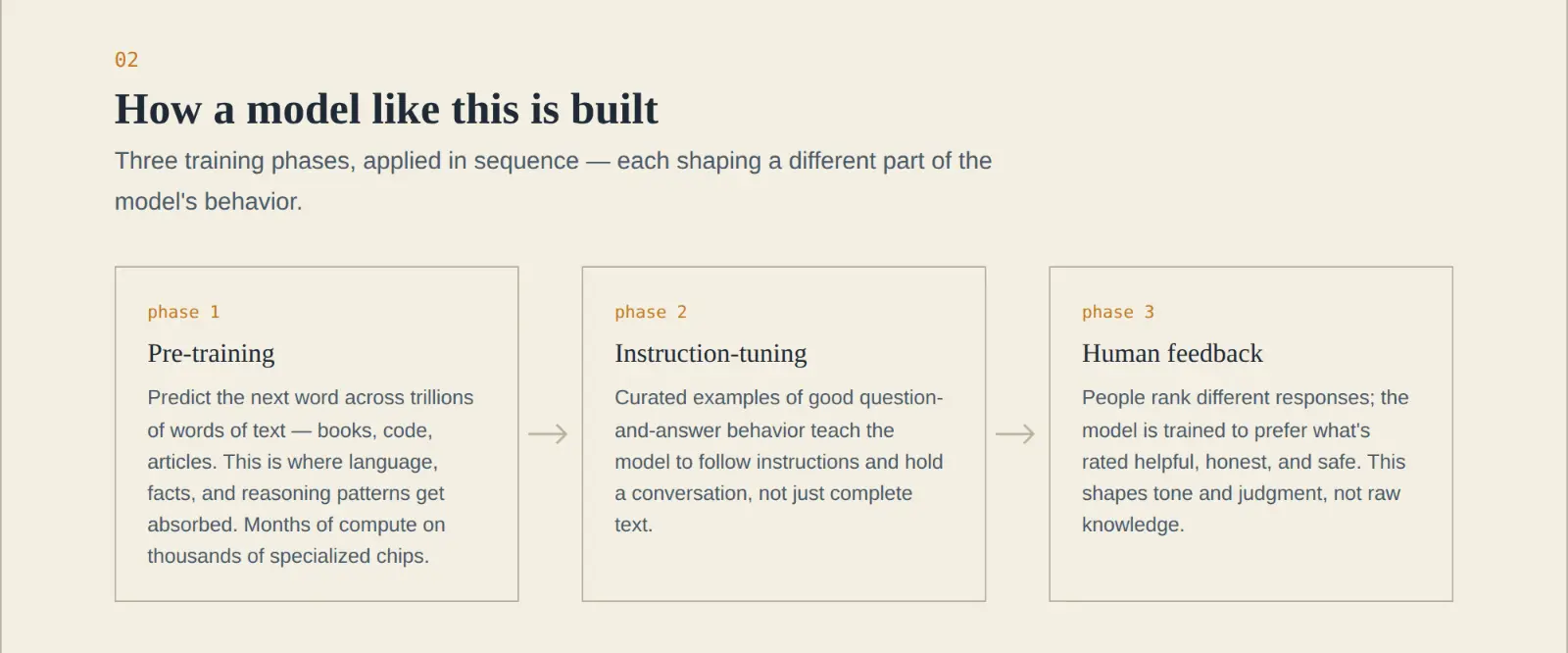
- 2022: RLHF (Reinforcement Learning from Human Feedback) papers show how to align raw language models to be helpful/safe conversational assistants — the technique that turned “text predictors” into “chatbots.”
Development milestones (the engineering)
- 2018–2019: BERT and GPT-2 show transformers work well for real language tasks.
- 2020–2022: GPT-3, then diffusion models (image gen: DALL-E, Stable Diffusion) show generative AI works across modalities, not just text.
- 2022–2023: Chain-of-thought prompting and instruction-tuning become standard — models get much better at multi-step reasoning without architecture changes, just better training/prompting technique.
- 2023–2024: Multimodality becomes standard (models that natively handle text + images + sometimes audio/video in one system); context windows balloon from ~4K tokens to hundreds of thousands, then millions.
- 2024–2026: “Reasoning models” (extended thinking before answering) and agentic AI — models that use tools, write/execute code, and take multi-step autonomous actions — become the frontier. By early 2026, multiple providers had launched production-ready AI agent frameworks, with autonomous systems starting to handle complex multi-step business workflows.
Commercialization milestones (the business impact)
- 2016: Google’s AlphaGo beats world Go champion — first mass-media “AI moment,” though not commercial per se.
- 2021–2022: GitHub Copilot launches — first mainstream AI coding assistant, proof AI could be a paid, embedded developer tool.
- Nov 2022: ChatGPT launches — the true commercialization inflection point. 100M+ users in 2 months; every major tech company reorganizes around AI within a year.
- 2023–2024: The “AI arms race” — Microsoft/OpenAI, Google Gemini, Anthropic Claude, Meta Llama (open-source), all racing on both consumer products and enterprise APIs. AI gets embedded into Office, Search, Slack, etc.
- 2025–2026: Model releases accelerate dramatically — 2025 alone saw 25+ notable flagship releases across OpenAI, Anthropic, Google, Meta, DeepSeek, Alibaba, Mistral, and xAI, with new significant releases landing almost monthly. Massive capital commitments emerge too — the Stargate Project, a joint venture between OpenAI, SoftBank, Oracle, and MGX, was formally announced in January 2025 as a large-scale AI infrastructure buildout. The center of gravity shifts from “chatbot” to agentic products — coding agents, autonomous research tools, and business workflow agents — as the new commercial battleground.
Top 5 inventions/patterns underlying this whole history
If you strip away the noise, almost everything above traces back to five ideas:
- The Transformer architecture (2017) — the mechanism that lets a model weigh the relevance of every word against every other word in a sequence (“attention”), enabling parallel training at massive scale. Without this, none of the current generation of models exist in their current form.
- Scaling laws (bigger model + more data + more compute = predictably better performance) — this shifted the entire industry’s strategy from “invent smarter algorithms” to “build bigger training runs,” which is why AI progress became a capital-intensive, infrastructure-driven race (data centers, chips, energy).
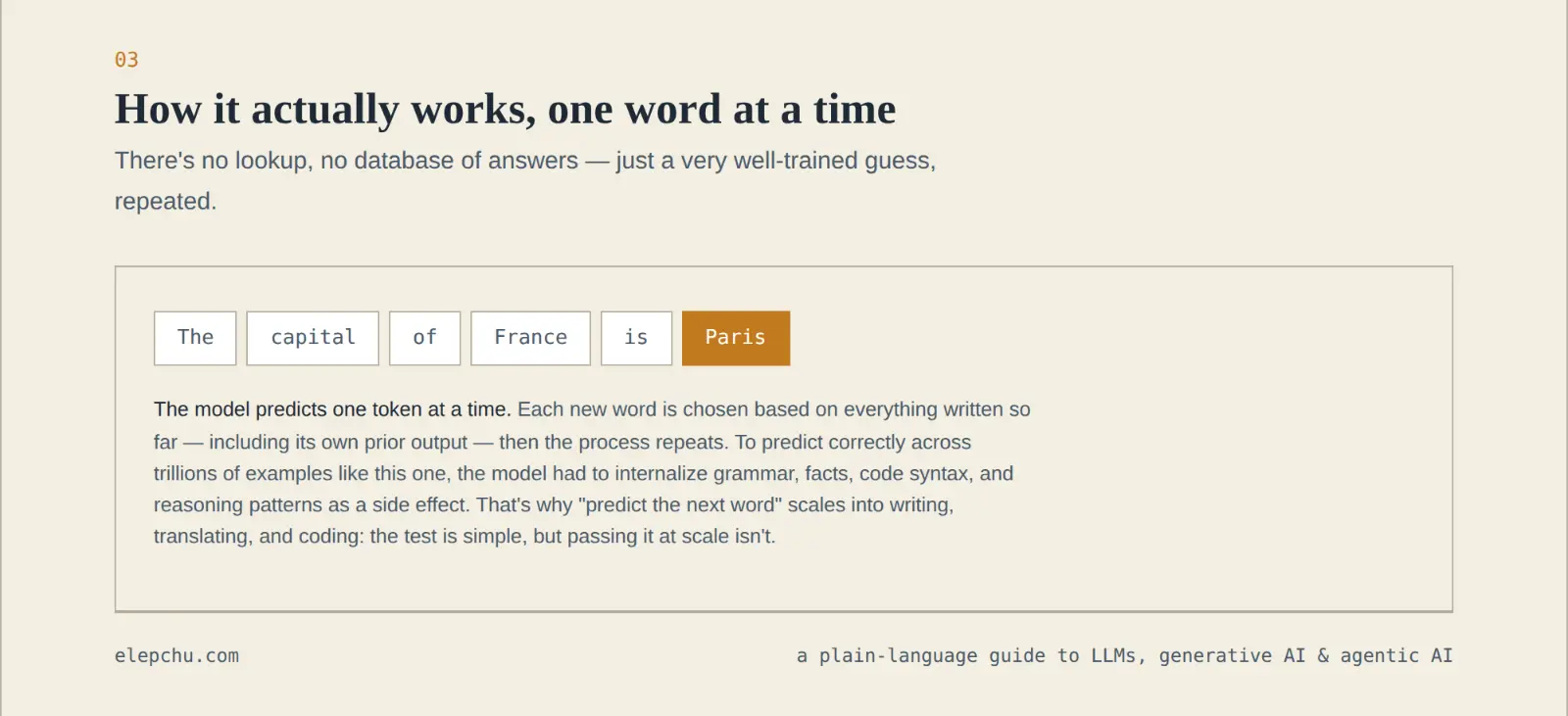
- Self-supervised pre-training — the trick of training on raw, unlabeled text (predict the next word) instead of needing humans to hand-label everything. This unlocked training on effectively the entire internet, which is why capability jumped so fast once compute caught up.
- RLHF / alignment techniques — turning a raw “autocomplete engine” into something that follows instructions, refuses harmful requests, and behaves like an assistant. This is the difference between GPT-3 (research curiosity) and ChatGPT (product people use daily).
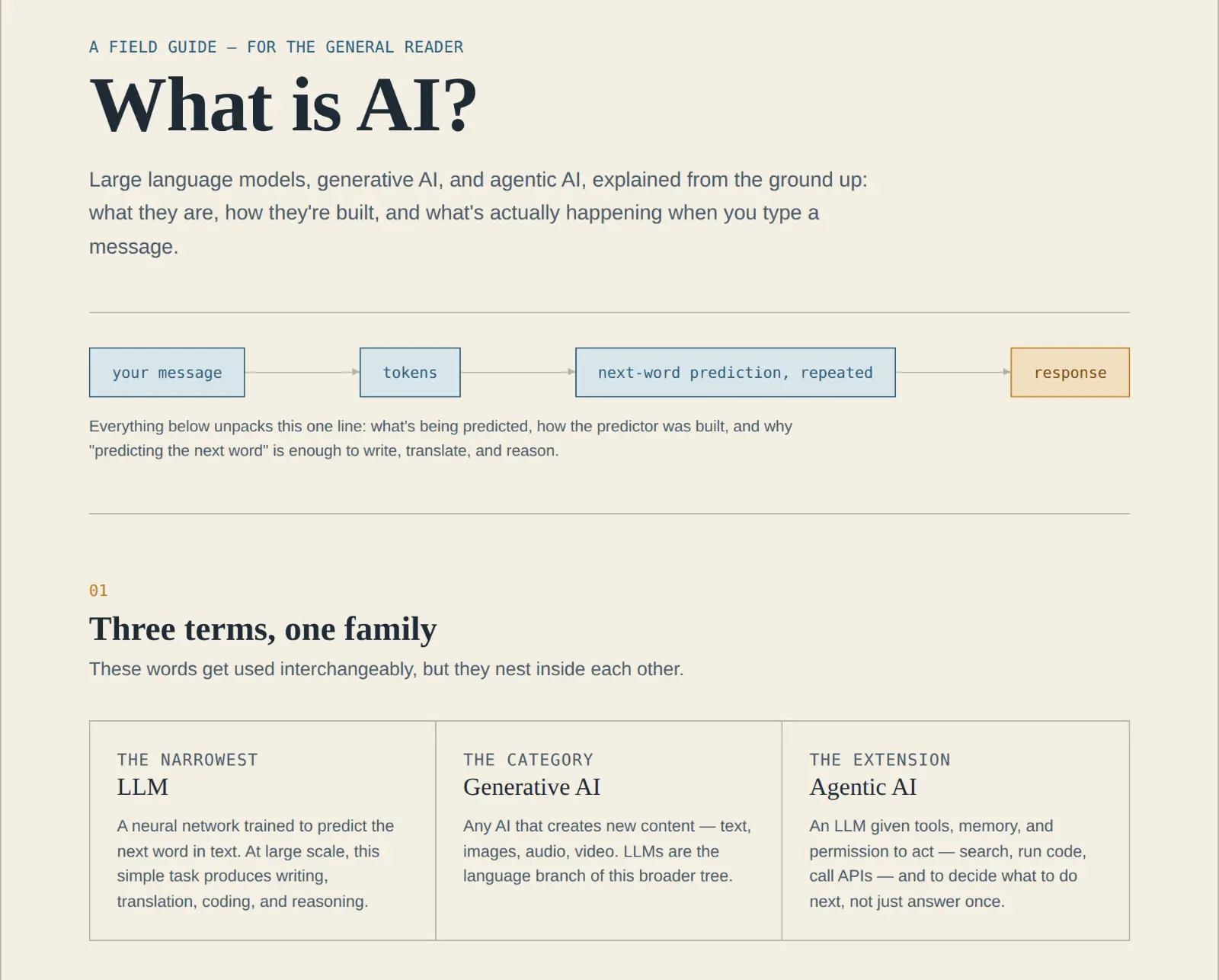
- Tool use / agentic loops — giving models the ability to call external tools (search, code execution, APIs) and decide what to do next based on results. This is the current frontier, and it’s the shift from “AI that answers questions” to “AI that does work”.
Names behind the “Top 5” inventions
- Transformer architecture (2017) — “Attention Is All You Need,” 8 authors at Google Brain/Google Research: Ashish Vaswani, Noam Shazeer, Niki Parmar, Jakob Uszkoreit, Llion Jones, Aidan Gomez, Łukasz Kaiser, Illia Polosukhin. No single “star” — genuinely a team paper, though Vaswani and Shazeer are most often cited as the driving forces. Notably, several of these authors later left Google to found other AI labs (Character.AI, Adept, Inceptive, Cohere).
- Scaling laws — most associated with OpenAI researchers, particularly a 2020 paper led by Jared Kaplan (with Sam McCandlish and others), plus the GPT-3 effort itself under Ilya Sutskever (then OpenAI’s Chief Scientist) and Alec Radford (lead author on the original GPT paper). DeepMind’s “Chinchilla” paper (2022, led by Jordan Hoffmann) later refined the scaling laws significantly.
- Self-supervised pre-training — no single inventor; it’s a decades-old idea in ML applied to language at scale. Yoshua Bengio did foundational early work on neural language modeling (2000s). Alec Radford (OpenAI) is generally credited with showing it worked spectacularly well for generative language models via GPT-1/GPT-2.
- RLHF / alignment — the technique traces to a 2017 DeepMind/OpenAI paper by Paul Christiano, Jan Leike, and others. It was operationalized into ChatGPT-style assistants by OpenAI’s alignment team, with Jan Leike and John Schulman especially associated with it (Schulman also co-invented PPO, the RL algorithm RLHF typically uses). Long Ouyang led OpenAI’s InstructGPT paper (2022), the direct precursor to ChatGPT.
- Tool use / agentic AI — much more diffuse and recent; no single named inventor. Key contributing work includes ReAct (2022, Shunyu Yao et al., Princeton/Google), and rapid productization by all major labs (OpenAI’s function calling, Anthropic’s tool use/MCP, etc.) through 2023–2025.
Top 5 people in AI history (broader, if you want a “Mount Rushmore”)
If forced to pick five people whose influence spans the whole field, not just one invention:
- Geoffrey Hinton — “Godfather of Deep Learning.” Backpropagation, decades of foundational neural network research, co-won the 2024 Nobel Prize in Physics for neural network foundations. Left Google in 2023 specifically to speak more freely about AI risk.
- Yann LeCun — Convolutional neural networks (the foundation of computer vision), Chief AI Scientist at Meta, another of the “deep learning godfathers” alongside Hinton and Bengio (all three won the 2018 Turing Award together).
- Ilya Sutskever — Hinton’s student; co-authored AlexNet (2012, the deep learning “big bang” moment); co-founded and was Chief Scientist at OpenAI, central to GPT-1 through GPT-4; later left to found Safe Superintelligence Inc.
- Demis Hassabis — Co-founder and CEO of DeepMind; led AlphaGo and AlphaFold (arguably the most scientifically consequential AI application to date — solved the 50-year protein folding problem); shared the 2024 Nobel Prize in Chemistry for AlphaFold.
- Sam Altman — Not a researcher, but arguably the most consequential commercializer: CEO of OpenAI, drove the ChatGPT launch and the current AI investment/product race more than any other single individual.
Honorable mentions worth knowing: Andrew Ng (education/popularization, Coursera, led Google Brain and Baidu AI), Fei-Fei Li (created ImageNet — the dataset that made the 2012 AlexNet moment possible), Yoshua Bengio (third of the Turing Award trio, major voice on AI safety), and Dario Amodei (OpenAI’s former VP of Research, left to co-found Anthropic — the company behind the model you’re talking to now).
↑ Back to top